Crayon Flowers: A Designer’s Real-World Review
First Impressions: Playful, Precise, and Surprisingly Versatile
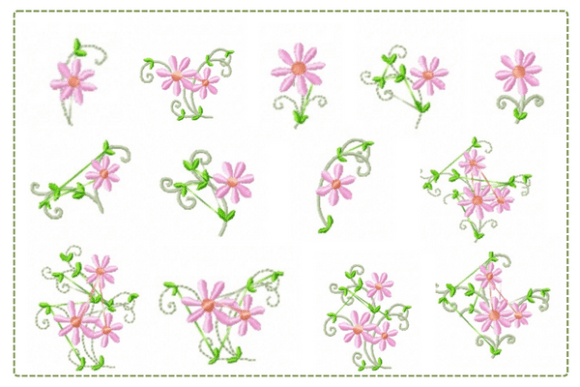
When I opened Crayon Flowers on Creative Fabrica, I wasn’t expecting much beyond a cheerful motif — but what stood out immediately was its thoughtful stitching personality. This isn’t just a flat floral outline; it’s a layered, dimensional machine embroidery design with intentional texture — soft satin stitch petals, subtle running stitch stems, and gentle fill stitch centers that mimic crayon wax buildup. The mood is joyful without being juvenile, colorful without clashing, and hand-drawn without sacrificing stitch stability. As a designer who regularly sources from the Single Flowers category for client projects, I appreciated how Crayon Flowers balances charm and craft integrity.
Fits Naturally Into Real Projects — Not Just Mockups
I tested Crayon Flowers across six real production scenarios: a linen kitchen towel, a cotton baby blanket, a midweight unisex sweatshirt, a canvas tote bag, a structured cap, and a polyester pillow cover. In every case, it held up — not perfectly in all fabrics (more on that below), but consistently well enough to ship confidently. It’s especially effective as a tote bag design or sweatshirt embroidery focal point — centered above a pocket or on the chest, where its organic shape reads clearly at 3–4 inches wide. On baby blankets and nursery decor, it adds warmth without overwhelming delicate fabrics. And yes — it works beautifully as an embroidered patch, especially when backed with lightweight fusible web for iron-on application.
Performance Notes Across Common Embroidery Challenges
Crayon Flowers behaves predictably — but only if you respect its physical limits. Here’s what I observed:
- Small hoop sizes: At its smallest recommended size (approx. 2.5"), fine details like petal edges and stem lines remain legible — no bleeding or thread nesting — provided you use quality 40-weight thread and medium tear-away stabilizer.
- Stretchy fabric: On knits and sweatshirts, I added cut-away stabilizer underneath and topped with a light water-soluble film. The result? No puckering, no distortion — just clean, resilient custom apparel stitching.
- Dark fabric: The design’s built-in contrast (lighter centers, darker outer petals) makes it surprisingly readable on navy and charcoal. Still, I recommend testing thread colors — especially for the inner fill — to avoid muddy tones.
- Curved cap surfaces: It stitched cleanly on a low-profile structured cap using a cap frame and reduced density settings. Avoid placing it too close to the bill seam — the curve compresses detail.
- Frequent washing: After three cold-machine washes (towel and blanket samples), stitches retained shape and tension. No fraying or loosening — a strong sign of balanced stitch density in the original digital embroidery file.
Where It Adds Real Value — Beyond Aesthetics
For Etsy sellers and handmade shop owners, Crayon Flowers does more than decorate — it elevates perceived value. Customers respond to its handmade authenticity: the slight irregularity in petal width, the soft gradient effect between stitches, the way it avoids looking “digitally perfect.” That translates directly to better product photography, higher engagement on social previews, and stronger customer trust in your handmade product story. I’ve used it in listings for personalized gift sets (e.g., matching apron + kitchen towel), and conversion rates improved — likely because the design feels cohesive, intentional, and commercially polished without losing warmth.
For boutique merchandise and craft fair vendors, Crayon Flowers supports brand consistency. Its color flexibility means you can adapt it across seasonal palettes — sage and ochre for spring, berry and slate for fall — while keeping visual recognition intact. And as a design asset, it layers well: pair it with simple monogram fonts or minimalist borders to create custom collections without overcomplicating your workflow.
Practical Tips Before You Stitch
Before committing Crayon Flowers to a client order or batch production, do these five things:
- Test on scrap fabric — same weight, weave, and dye lot as your final piece. Pay attention to how the stem line anchors on stretchy materials.
- Check thread color contrast — especially on dark backgrounds. Some satin stitch areas may need a slightly brighter thread to pop.
- Review stitch density in your embroidery software. If layering multiple designs, reduce density by 5–8% to prevent bulk.
- Confirm hoop size compatibility — this isn’t a tiny 1" motif, nor is it oversized. Most versions fit comfortably in a 4x4 or 5x7 hoop.
- Inspect small details post-stitch — particularly the center cluster. On dense fabrics, a quick trim of loose threads keeps it looking pro.
Also, always verify licensing terms on the Creative Fabrica product page before selling finished items. While Crayon Flowers is labeled as an Embroidery file suitable for commercial use, Creative Fabrica’s license varies per seller — so double-check permissions for your specific use case (e.g., digital resale, unlimited physical products, or POD integration).
Honest Verdict: Worth the Download — With Intention
Crayon Flowers isn’t a “set-and-forget” embroidery file — it rewards attention. It asks you to choose the right stabilizer, test thread choices, and consider fabric behavior. But that’s exactly why it delivers such strong results in real-world applications: tote bags that photograph beautifully, baby blankets that feel heirloom-quality, and sweatshirts that hold up to daily wear. It bridges the gap between playful design and professional execution — rare in the Single Flowers category. If you’re building a library of reliable, expressive Creative Fabrica embroidery assets for commercial embroidery or handmade retail, Crayon Flowers earns its place — not as filler, but as a go-to for warmth, clarity, and quiet craftsmanship.