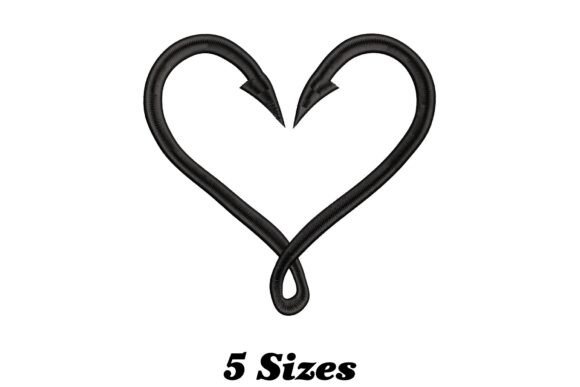
Fishing Hook Heart
A Playful, Polished Touch for Boutique Apparel
As an embroidery designer who’s developed collections for small clothing brands and Etsy sellers over the past 12 years, I approach every Creative Fabrica embroidery file with two questions: Does it hold up in production? And does it elevate the finished product—not just as decoration, but as brand language? Fishing Hook Heart passed both tests before I even hooped my first scrap. Visually, it’s whimsical without tipping into cutesy—clean curves, balanced negative space, and a subtle nod to rustic charm that reads equally well on a linen tote or a heavyweight hoodie. It doesn’t shout; it winks. That quiet confidence makes it ideal for boutique apparel where subtlety builds recognition.
How Fishing Hook Heart Performs Across Apparel Types
For sweatshirt embroidery, Fishing Hook Heart shines on chest placement—especially on neutral heather grays, oatmeals, and soft blacks. Its compact shape (no sprawling branches or fine filigree) avoids bulk while still reading clearly from three feet away. On oversized hoodies, I tested it centered just below the collarbone—no distortion, no puckering. The stitch density feels intentional: dense enough to hold structure on fleece, light enough to drape naturally over ribbed fabric textures.
As a hoodie design, it works beautifully on sleeves—angled slightly above the elbow on a relaxed fit. Unlike many camping-themed embroidery files that lean heavily into ruggedness, Fishing Hook Heart balances outdoorsy spirit with gentle femininity. That duality helps it cross seasonal lines: pair it with sage green thread on a spring hoodie, then switch to burnt orange for fall layers.
On t-shirt embroidery, especially lightweight blends, I recommend testing stabilizer first—medium-weight cutaway works best for stretch control without stiffness. The design’s smooth outer contour handles curved surfaces (like shoulder seams or side seams) without distortion. For tote bag design, it anchors beautifully near the top seam or centered on the front panel—its visual weight holds its own against canvas or heavy cotton duck.
In custom apparel contexts—think limited-run drops for a small shop product line—Fishing Hook Heart adds personality without overwhelming. It’s versatile enough to sit beside minimalist typography or layered beneath a subtle watercolor print in lifestyle product photos. For Etsy sellers, it’s a strong candidate for printable mockups: clean edges render crisply in PNGs, and its scale translates well across thumbnail sizes on mobile feeds.
Where to Place It—and Where to Pause
Fishing Hook Heart excels in small chest placement, but avoid placing it directly over thick seams or double-layered hems unless you’ve pre-tested tension. On dark garments, contrast is your friend—cream, pale mint, or warm taupe thread colors lift the design without looking stark. I found it performs reliably on denim jackets when paired with tear-away stabilizer and a sharp needle—no skipped stitches in the hook curve.
That said, steer clear of ultra-stretchy performance knits without added support: the heart’s rounded shape can subtly distort if the fabric gives too much during stitching. Also, skip tight placements near armpits or waistbands—areas prone to stretching or wrinkling post-wash. And while it’s charming at 2.5", resist shrinking it below 2"—the inner details (like the gentle taper of the hook) start to blur at smaller scales.
Design Integrity Meets Commercial Practicality
This isn’t just another machine embroidery design you drop into a folder—it’s a branding asset. When used consistently across a collection (e.g., same thread color, same chest placement on all sweatshirts), Fishing Hook Heart becomes a quiet signature. Customers begin to associate that shape with your boutique brand’s warmth and intentionality. That consistency builds buyer trust: it signals care in execution, not just aesthetics.
For commercial embroidery, its clean construction means fewer re-hooping moments and smoother transitions between garment types. No tiny lettering to misalign, no nested fill areas that trap lint. It’s forgiving for newer digitizers learning how to balance stitch density and fabric texture—but still refined enough for seasoned shops aiming for premium presentation.
Designer Notes Before You Stitch
- Test on scrap fabric—especially if using fleece, terry cloth, or ribbed knit. Observe how the heart’s curve settles after washing.
- Confirm stabilizer choice: medium cutaway for most apparel; tear-away for stable wovens like denim or canvas.
- Review thread color contrast carefully on dark or textured fabrics—what reads well on screen may mute on garment.
- Verify hoop size and design dimensions against your machine’s limits—some versions may include multiple sizes; choose intentionally.
- Inspect stitch density in the hook’s bend—overly dense fills can cause stiffness on soft knits.
- Always test on similar garment fabric, not just quilting cotton. Sweatshirt fleece behaves differently than cotton poplin.
- Compare placement options using a washable fabric marker—sometimes ¼" higher or lower changes everything.
- Double-check Creative Fabrica product details and licensing before selling finished apparel—especially for commercial embroidery use.
Final Thought: Charm With Craftsmanship
Fishing Hook Heart stands out in the Camping category not by leaning into cliché, but by reimagining it with warmth and restraint. It’s a digital embroidery file that feels handmade—not because it’s imperfect, but because it’s thoughtfully composed. For small shop owners building a cohesive, emotionally resonant line, it’s more than a design. It’s a quiet invitation: to pause, to connect, to wear something that feels both familiar and freshly made. Whether stitched on a cozy seasonal hoodie or a minimalist t-shirt for summer markets, Fishing Hook Heart earns its place—not as filler, but as finish.